A handy list of poisons for writing reference, provided to you by me, Bella
Poisoning is one of the oldest murder tactics in the books. It was the old equalizer, and while it’s often associated with women, historically men are no less likely to poison you. This is not a guide on how to poison people, you banana bunches, it’s a guide on writing about poisons in fiction so you don’t end up on a watch list while researching them. I’ve taken that hit for you. You’re welcome. These are just a few of the more classic ones.
Hemlock: Hemlock (conium maculatum) is one of the more famous ones, used in ancient times most notably in Socrates’ forced suicide execution. So it goes. The plant has bunches of small, white flowers, and can grow up to ten feet tall. It’s a rather panicky way to die, although it wouldn’t show: hemlock is a paralytic, so the cause of death is most often asphyxiation due to respiratory paralysis, although the mind remains unaffected and aware.
Belladonna: Atropa belladonna is also called deadly nightshade. It has pretty, trumpet-shaped purple flowers and dark, shiny berries that actually look really delicious which is ironic since it’s the most toxic part of the plant. The entire plant is poisonous, mind you, but the berries are the most. One of the most potent poisons in its hemisphere,it was used as a beauty treatment, so the story says, and rubbed into the eyes to make the eyes dilate and the cheeks flush. Hench the name beautiful lady. The death is more lethargic than hemlock, although its symptoms are worse: dilated pupils, sensitivity to light, blurred vision, tachycardia, loss of balance, staggering, headache, rash, flushing, severely dry mouth and throat, slurred speech, urinary retention, constipation, confusion, hallucinations, delirium, and convulsions. It’s toxic to animals, but cattle and rabbits can eat it just fine, for some reason.
Arsenic: Arsenic comes from a metalloid and not a plant, unlike the others here, but it’s easily the most famous and is still used today. Instead of being distilled from a plant, chunks of arsenic are dug up or mined. It was once used as a treatment for STDs, and also for pest control and blacksmithing, which was how many poisoners got access to it. It was popular in the middle ages because it looked like a cholera death, due to acute symptoms including stomach cramps, diarrhea, confusion, convulsions, vomiting, and death. Slow poisoning looked more like a heart attack. The Italians famously claimed that a little arsenic improved the taste of wine.
Strychnine: Strychnine (strick-nine) is made from the seed of strychnos nux vomica and causes poisoning which results in muscular convulsions and eventually death through asphyxia. Convulsions appear after inhalation or injection—very quickly, within minutes—and take somewhat longer to manifest after ingestion, around approximately 15 minutes. With a very high dose, brain death can occur in 15 to 30 minutes. If a lower dose is ingested, other symptoms begin to develop, including seizures, cramping, stiffness, hypervigilance, and agitation. Seizures caused by strychnine poisoning can start as early as 15 minutes after exposure and last 12 – 24 hours. They are often triggered by sights, sounds, or touch and can cause other adverse symptoms, including overheating, kidney failure, metabolic and respiratory acidosis. During seizures, abnormal dilation, protrusion of the eyes, and involuntary eye movements may occur. It is also slightly hallucinogenic and is sometimes used to cut narcotics. It also notably has no antidote. In low doses, some use it as a performance enhancer.
Curare:Chondrodendron tomentosum is lesser known than its famous cousins, but kills in a very similar way to hemlock. It is slow and terrible, as the victim is aware and the heart may beat for many minutes after the rest of the body is paralyzed. If artificial respiration is given until the poison subsides, the victim will survive.
Wolfsbane: Aconitum has several names; Monkshood, aconite, Queen of Poisons, women’s bane, devil’s helmet) and is a pretty, purple plant with gourd-shaped flowers. The root is the most potent for distillation. Marked symptoms may appear almost immediately, usually not later than one hour, and with large doses death is near instantaneous. Death usually occurs within two to six hours in fatal poisoning. The initial signs are gastrointestinal including nausea, vomiting, and diarrhea. This is followed by a sensation of burning, tingling, and numbness in the mouth and face, and of burning in the abdomen. In severe poisonings pronounced motor weakness occurs and sensations of tingling and numbness spread to the limbs. The plant should be handled with gloves, as the poison can seep into the skin.
Foxglove: Digitalis is large with trumpet-shaped flowers that can be many colors, but usually a pinkish shade. It may have from the term foxes-glew, which translated to fairy music. Intoxication causes nausea, vomiting and diarrhea, as well as sometimes resulting in xanthopsia (jaundiced or yellow vision) and the appearance of blurred outlines (halos), drooling, abnormal heart rate, cardiac arrhythmias, weakness, collapse, dilated pupils, tremors, seizures, and even death. Slowed heartbeat also occurs. Because a frequent side effect of digitalis is reduction of appetite and the mortality rate is low, some individuals have used the drug as a weight-loss aid. It looks a bit like comfrey, which is an aid for inflammation. Make sure not to confuse the two.
Hello Friends! Today, we’re going to look at some common house terms, specifically related to roofs, dormers, porches, (and a couple diversions, of course). These terms will give you a foundation for how to talk about everyday houses, and give you an idea of how to classify houses by their basic shapes.
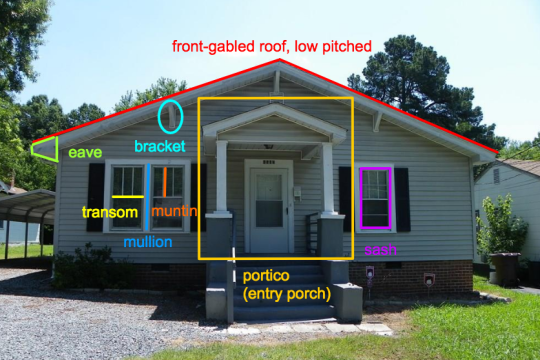
Even a very simple house like the one above can provide us ample opportunity to practice our terminology. This house has elements borrowed from “higher” styles, such as the decorative brackets commonly found in the Craftsman style, but ultimately it’s as common as a common house can get. Still, it gives us an opportunity to relearn terms we might have forgotten, like the different parts of a window.
The easiest starting point for talking about houses is the roof, as roofs are a great way to group similar types of houses without relying on style.
Roofs
Common Roof Shapes:
Sometimes roof terminology can get tricky. For example, the gambrel roof is a shape of roof, but there can be front-facing and side-facing gambrels (the example above is side-facing.) Center-gabled roofs are often confused for cross-gabled roofs.
Uncommon Roof Shapes:
Shed roofs, while very common on dormers, porches, and additions, didn’t really come into vogue as a distinct roof shape like the example above until the 1960s. Hipped with Cross-Gable roofs are found usually on large Queen Anne-styled houses, though there are some exceptions (they are, of course, the prototypical nub). Mansard style roofs look different on rowhouses than they do detached houses, and in later houses look almost gambrel-like, such as the example above.
Sometimes it’s difficult to tell what’s going on with a roof, like in the example below:
In this example, while the gable is centered, it’s technically a cross gable because it is attached to a projecting mass from the main body – the two masses “cross” in a T-shape, making it a cross-gable. Were the entire front facade one mass instead of two, with the gable flush rather than attached to a projecting mass, it would be a center-gabled house instead.
Eaves and other Decorations
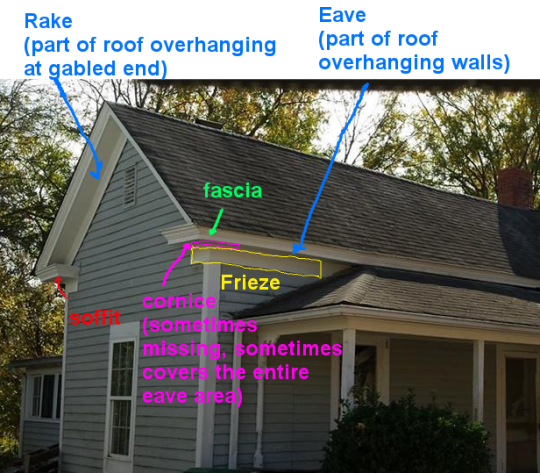
Some of these are terms you can use to impress your friends (I know I definitely get some looks when I throw down the word ‘fascia’ at parties), but the key terms to remember here are rake and eave. The rake is the part of the roof that overhangs the gabled end, whereas the eave is the part of the roof that overhangs the side walls.
The cornice is commonly referred to as the “trim”. The frieze is kind of like a baseboard but for the roof, and, like the cornice, is omitted on some more plain houses.
When the eaves have a closed soffit (some eaves have open soffits, like on craftsman houses), they are called “boxed” or “closed” eaves. On newer houses, gutters often cover the fascia.
On some common houses, some roofs are more ornamental, for example, on even the plainest of Craftsman bungalows, there are a lot of interesting details:
Dormers
The names of dormers follow the shape of their respective roofs. A dormer with a gabled roof is a gabled dormer, for example. Some dormers earn their names for other reasons, however, hence this handy guide:
A few subtypes of common houses are recognizable by their dormers, such as the adorable twin gabled dormers of so-called “Cape Cod”:
However, it is important to note that the Cape Cod isn’t it’s own style, but rather a specific layout common to Minimal Traditional houses. Houses with gambrel or mansard roofs and split-level colonials (such as the example used for the “wall dormer” above) usually have embedded wall dormers above or through the cornice line.
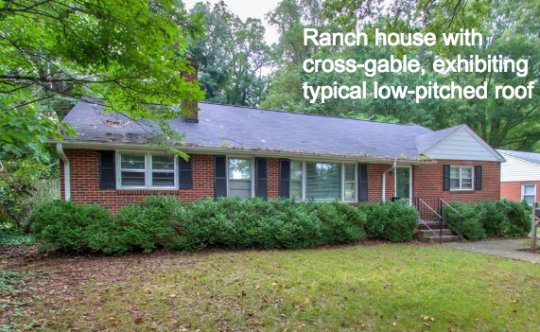
Some houses are notable for their lack of dormers. The rooflines of ranch houses, for example, are too low-pitched for any significant second story space – ranch houses, rendering dormers pointless:
Porches
Ahh yes, time for @porchrates favorite part of the post. Porches are commonly described by their height and how much of the house they take up:
A portico is another name for a covered entry porch. The gabled part of a portico is called a pediment, because on many classically styled houses (e.g. Greek Revival or Neoclassical), they borrow the proportions and pared-down details of the pediments found in usually Greek (but sometimes Roman) temple architecture.
A wrap porch (a porch that extends around to at least one adjacent side of the house) is often called a veranda, though this usually refers to porches that wrap around at least three sides of the house, such as the porches commonly found on Southern Colonial plantation homes and large, rambling Queen Anne houses. A porch that covers the full facade is called a full-facade porch.
Full-facade porches are in some way integrated into the roofline (they may be interrupted by dormer(s), like in the example above). If there is a gap between the top of the porch and the eaves of the roof, the porch is sometimes referred to as a full-width porch rather than a full-facade porch.
One last thing about porches: houses with very shallow porches (less than 4 feet) have either had the porch put on as an addition, or, more likely, the porch is decorative – a clear sign of a house built in the last 30 years.
(Insert Joke™ about something something new houses something something shallow)
Anyways, folks, that does it for Round One of Common House Terms! Stay tuned for a special Labor Day week of McMansion Hell, with a New Hampshire McMansion tomorrow, a New Jersey (!!!) McMansion on Tuesday, and the next installment of Common House Terms: Materials and Windows on Saturday!!
OH AND ONE MORE THING
Are YOU in the Baltimore metro area?? Do you want to witness me give a live diss on McMansions and talk about my rad as hell politics in one of the 3 coffee shops I write this blog in? Well you’re in luck because Thursday, September 7th, I’ll be doing a McMansion Hell LIVE event at Red Emma’s Bookstore & Coffeehouse. More info here, if you’re up to it.
If you like this post, and want to see more like it, consider supporting me on Patreon!Also JUST A HEADS UP – I’ve started posting a GOOD HOUSE built since 1980 from the area where I picked this week’s McMansion as bonus content on Patreon!
Okay so most of this is bullshit (Eggsy and Roxy apparently being 32, the events of KM1 happening in 2012 instead of 2014, the end of KM1 being in September when we know that it happened directly after the Royal Ascot which is in June, etc), but it is really nice to know a few more codenames and corresponding faces. So for those that may need reference for fic that takes place before, ignores, or retcons TGC with canon divergence:
Note: Lancelot and Percival are switched in TGC but that could just be for framing.
And for anyone needing a list of prominent Arthurian knights (there were a lot of them but there were only a select number that are mentioned most commonly) here’s a list. My personal faves for the remaining three are Kay, Bors, and Tristan.
Adding more meta bc I have no self control. As I said above, some of this stuff just can’t be taken as fact. It’s too wildly skewed and clearly written to fill space by people who didn’t know all the details. However there are a few things I felt were salvageable.
Of the Knights there are actually two new faces in TGC, the one at the end of the table and the back left:
For the one at the end of the table, it’s a little hard to tell the difference, but the cast listing shows us that two of the cast members at the table were swapped and process of elimination tells us it’s these two. When looking at pics that have a little closer view, you can also tell that the one in TGC is much younger than the one in TSS.
His seat appears to be Agent ‘Geraint’ and my resolution wasn’t clear enough to see the exact date that he was admitted, but it does appear to be in the 1990′s. We know that this can’t be right tho, bc his placement was occupied by someone else only a year before. So that will have to be ignored or retconned by personal headcanon.
Both actors have very little (and, in one of their cases, no) credit to their name outside of TGC, so it’s proven near impossible to find a picture of the new agent in the back.
Bottom line tho, I feel this fits well into the common headcanon that some Kingsman agents joined Chester and subsequently died during V-Day.
So an update to my previous image would be…
Other interesting little tidbits include:
Percival provided field training for Bedivere.
Bedivere was recruited at some point after 1995. (He started training for a Tank Regiment in September of 1995 so we can assume that he was probably recruited sometime afterward.)
Geraint in the first film is played by Nick English, founder of Bremont Watches. He was 43 in 2014 which is when TSS took place. The Geraint showed in TGC is listed as being born in 1972, making him around 42 at the time of TGC. Like I said, he’s listed as being admitted in the 90′s, tho that doesn’t make a lot of sense continuity wise.
Gawain was born in 1975 (12 Jan), making him around 39/40 in TSS/TGC. He was recruited in 2001 (3 Apr) when he was 26. Given that Chester King said at the beginning of TSS that they had not had an agent death in seventeen years, Gawain’s predecessor must have retired rather than dying in the field.
Lamorak was born in 1969 (14 Nov), making him around 44/45
in TSS/TGC. He was recruited in 1995 (10 May) when he was 25. While I personally headcanon that all of the agents can speak multiple languages, he is listed as specifically being able to speak five. Russian and Mandarin are among them.
Gambon!Arthur was born in 1940 (19 Oct), making him around 75 in TGC. He was recruited in 1960 (2 Dec) when he was 20.
Eggsy is listed as being voluntarily discharged from the Marines in June of 2008. This could be taken at face value, or it could be assumed that this is in relation to the incorrect date of 2012 listed as his and Roxy’s admittance date. In this case it would be four years before TSS (which took place in 2014) meaning that Eggsy left the Marines in 2010.
I have done this myself. This recipe works, and you’ll be shocked how home cooked Chic-Fil-A tastes just like the fast food, only better. When I get a little extra to grab the ingredients, I’m going to combine Chic-Fil-A style chicken strips and homemade Raising Cane’s sauce.
He’s tangibly shaking in your arms and very tense. It’s taking him every shred of strength, but he’s keeping himself from erupting. The tears are gentle when they touch your shoulder, and he isn’t making a sound. Each gasp for air is quick, sharp, deep. He is keeping it together. He is. He is.
ok this keeps coming on my dash and every time the notes are filled with people being like WHAT IS THIS so i am HERE TO ENLIGHTEN YOU, FRIENDS
this is from the musical Firebringer which is free to watch on Youtube. it’s by Team StarKid of A Very Potter Musical fame (think you recognize the girl singing? that’s Lauren Lopez, also known as the funniest Draco Malfoy the world has ever seen)
anyway, Firebringer is a female-driven, hilarious musical about bisexual cavewomen and you are going to want to watch it. trust me.






 FantasyBoudicca